
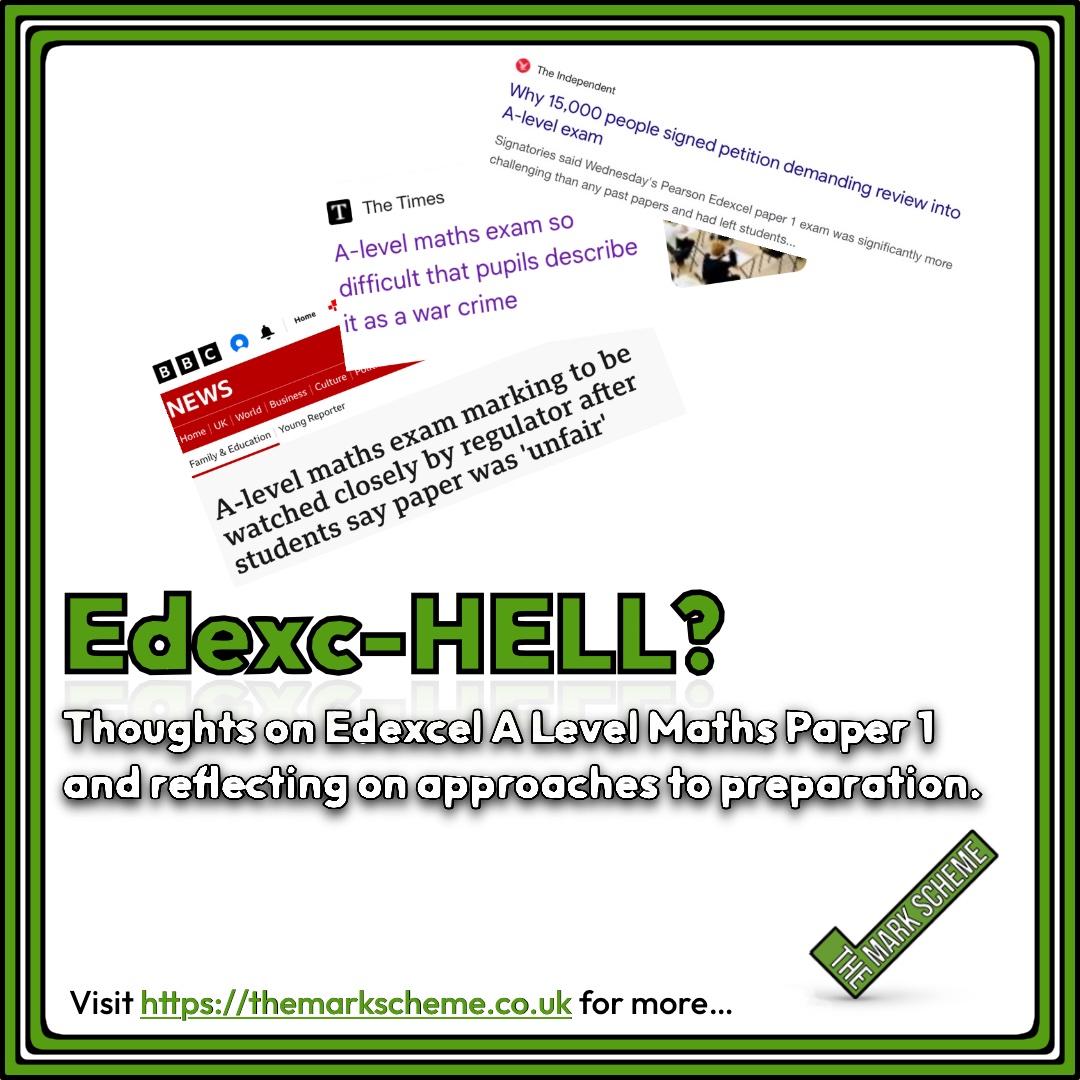
I was slightly hesitant to do this right now, it’s still very raw, and if young people stumble across this the things I’m going to talk about are not necessarily being shared at the time where behaviours can be adjusted for remaining examinations. I am going to be talking in some generalities here, and obviously what I am saying here will not be the case for all students, but particularly among the cohorts I am involved with, the reaction to Edexcel Maths Paper 1 has definitely caused some reflection with regards to approaches and how we direct learners towards revision.
What’s happened this time?
Edexcel A Level Maths paper 1 has been and gone. I must commend the efficiency in which Pearson have led to some form of “national event” occurring, we haven’t even had to wait until ‘paper 2’ (whatever happened last year – https://feweek.co.uk/replacement-a-level-maths-paper-lacked-key-topics/) or paper 3 (leaking in the hours before the exam in summer 2019 – https://www.bbc.co.uk/news/education-48646188) this time around for the national media to be able to jump on a bandwagon of petitions and broken dreams.
Was the paper challenging? I am relatively cursed with knowledge when it comes to A Level Maths, having taught now for over a decade. But, sitting on the fence, I’m going to say “Yes and No”.
By that, if you ask me. “Was it unfairly difficult?” “Was there material from outside of the specification?” “Was it unlike any paper released before?” No. Not at all. Not even close. It was very much an A Level Mathematics paper.
However, if you ask me if it was more challenging than other papers that have went before it, particularly those of the last couple of years? Yes. Yes it probably was. But why?
Where is the difficulty? – The decoupling of A Level and AS Maths
In A Level Maths, the area of most difficulty to many a student is the topic of integration. For some the number of anti-derivative methods they are expected to remember can feel overwhelming, especially how it’s often difficult to tell the correct method to take and choosing the wrong one culminates in disaster (but one that you don’t necessarily even notice). Then you have to factor for fiddly “notation” that is also not just simply “notation” at the same time. It can all be very confusing!
This year, 4 of the 15 questions on Paper 1 involved applying knowledge of integration. In raw terms this is not noteworthy in comparison to the last two years. 2024 also had 4 questions from 15 involving the topic, and 2025 had 3 from 16. However, something stood out from questions from this topic this year, but also others around them, in comparison to the most recent examinations that came before this.
Difficult out can be subjective, however within the A Level syllabus there is a fairly accepted way of apportioning relative difficulty. As well as the A Level qualification, a lesser, AS Level qualification also exists. All content from AS Maths is officially part of A Level maths, but the majority of learners studying towards an A Level will never sit an official AS Maths qualification, and the vast majority of content within the AS syllabus is built upon further within the full A Level syllabus. In 2025, one of the 3 integration questions was entirely built around AS methods (albeit with some A Level standard notation to interpret beforehand, the same notation also appeared this year). In 2024, one of the 4 questions was solvable with exclusively AS methods. By contrast, none of the 2026 exam questions on integration were solvable using methods from the AS syllabus.
Extending this beyond the topic of integration, in this week’s paper 1, only a single question of the 15 relied solely on skills and methods that are entirely on the AS Mathematics syllabus. It amounted for 5 marks. 5% of the exam paper. In 2024 AS exclusive methods would solve 3 whole questions of the 15 on the paper, accounting for 15% of the marks. Last year however, almost half of the questions on the examination were entirely solvable, simply using the methods that are also assessed in AS Level Mathematics. This amounted to a whopping 47% of the marks available on the exam!
Now, under the linear exam system, A Level Maths stands alone! All content is A Level Maths content! It’s not AS Level content and A Level content when it comes to the qualification, all of it is fair game. However, there is a reason the content that is mapped down to the standalone AS level is done so, and a large proportion is down the lines of mapping the old modular AS/A2 qualifications. The AS material is therefore, for the most part, objectively ‘easier’, it is the entry to the later topics.
Through that lens, was this a hard paper? Objectively, yes, but only if you are comparing to recent memory.
The discourse (eg. “war crimes”) is not exactly helping. AS it currently stands the top rated comment on the BBC article states “It’s not about the exam being hard! It’s about it not containing the topics that the teachers and the revision material gave to students to use for revising”. This implies skills and knowledge outside of the syllabus, and/or significant missing material on the exam. This is absolute garbage! There was nothing even remotely outside of specification here. Are some topics not there? Yes. But there’s a paper 2 next week which will address this (looks shiftily at 2025), but even still, of the 10 overarching specification areas in Pure Maths, 9 of them were part of this exam paper in some way.
Question Paper Improvements – the perils of “Show That” and the weight of public expectation
In 2020, Pearson started a process of modification of the A Level Maths assessments based on feedback and analysis of the early years of the qualification following the reform. Four driving principles were;
- Helping candidates get off to a good start
- Providing more restart opportunities
- Unlocking trapped marks assessing standard techniques (AO1)
- Making language more accessible and reducing reading time
The most recent review/examples of these type of changes can be found – HERE
These changes have manifested in a number of ways to make the exam papers genuinely more accessible. Early questions are weighted towards familiar topics, are often shorter, have less text and application, are easier to access. Larger questions often have bullet point information that can act as a checklist for students, meaning less cognition required to parse information and strategise. Questions are often broken into stages, in these cases allowing skills to be assessed before their application. This coincides with an increased prevalence of the “show that” question, a longstanding trope of A Level Maths, where a target answer is given allowing for students to re-enter a question at a later part, progressing through the rest of the problem.
Online feedback, including a quote in the BBC article is focussed on this. The lack of “show that” with re-entry points. Not every question needs this, nor have Pearson said that all question will have this. Take question 10 on the exam paper
Pt.a) Differentiation (likely quotient rule) – 5 marks
Pt.b) Find y-intercept, requires pt.a – 1 mark
Pt.c) Integration (likely inverse chain rule) and area of a shape combined in some way. Correct answer requires pt.b, which requires pt.a – 5 marks
This is one of the questions the I have directly seen Pearson criticised for not following the “show that” rule. But that’s not the approach that Edexcel/Pearson have applied to this problem to make it more accessible. What they’ve done is scaffolded the strategy for the problem by chunking the larger problem into smaller component steps. The exam board approach here is not to ”allow you to join later” as it’s conceptually one problem, they’ve just scaffolded the strategy for you, allowing for the focus one the methods required to complete the problem. In fact, here’s an example question requiring the same strategy (but with alternative calculus methods) from paper 2 in 2018, which wasn’t broken down.

For good measure, here’s one with the same strategic approach from AS Maths in 2018 as well, which also includes a “show that” scaffold for the final numerical answer, but not breakdown of approach.

We could get into a debate around psychology of a student sitting an exam at this point. This I would be more inclined to accept. During an open ended question like 2018, the learner may not recognise the overall strategy and the importance of differentiation to the problem, instead drawn to the shaded region and having their brain shout “integration!” at them. Therefore they will likely attempt the integration of the curve, picking up potentially 2/3 marks even if they can’t piece together the full strategy. Now however, as the strategy is directly shared, if a learner can’t get a satisfactory solution to pt.and pt.b, they are aware how relevant these solutions are to the outcome of pt.c. They may therefore choose not to pursue the elements of pt.c that would gain them marks, losing the 2/3 marks that could be gained from the unstructured question, because they know they are lacking the elements to succeed in pt.c.
The counter-argument would be that listing the strategy provides a potential for net gain in marks, especially if students switch that part of their brain off that would prevent some working in pt.c. Some will still argue, how hard would it be to make pt.b a “show that” with the given y-intercept, which would make pt.c fully accessible. Then you run the risk of over-scaffolding. You’ve already significantly simplified a problem by taking the need to strategise away from the learner, it’s also likely that 2/3 marks of the 5 for pt.c will still available without pt.a/b if it is attempted.
There are fewer “show that” problems with a given solution on this exam, only one on the exam paper (with another where the rearrangement that would normally be a “show that” is just given for students to use). Some of this is due to the type of question and topic that is being assessed on this paper. “Show that” often appears with Trigonometric identities (the one on this paper), iteration (the rearrangement is literally given instead on the exam paper), parametric integration/integration by substitution (not on the exam paper), before polynomial division (not on the paper) or optimisation/modelling with differentiation (not on the exam paper). Other questions on the paper would arguably be fundamentally changed if solutions were provided, the knowledge and skills they were trying to assess can then effectively be bypassed.
For example, the much discussed Q7, which requires knowledge of sin(x) = sin(pi – x). This is a basic conceptual idea in trigonometry. One that realistically we would want all A Level maths learners to be aware of. It’s not necessarily thought about in this way, as learners will often think about this in the context of the sine rule anomaly or as a procedure they do to get additional solutions. For that reason, it’s a great knowledge question! The form of the answer is given as psintheta +qtheta -2pi = 0. If you KNOW what the target p is, it completely alters the question, and it no longer assesses that key piece of knowledge. If you know the coefficient, you switch sin(pi – x) for sin(x), purely because that is what gives you the coefficient. It’s therefore no longer fit for purpose as a question!
Q13 with the geometric series and trigonometry is a type of question that has also historically given the target for pt.a for something like this. However, I can again understand and support the decision not to do it here. Strategy wise, giving the solution for r opens up a much simpler approach to the question that reduces the algebraic burden for the learner. It’s a late question on a paper, challenge is wanted!
In total, these questions that could arguably have been provided a “show that” target answer in other years, prevent access to 6 future marks, out of 100. It’s a price, but realistically, it is not extravagant, especially for examiners to be able to assess knowledge and skills in the way in which they would like.
With increased accessibility, the natural inflation of grade boundaries will follow. The papers become more accessible, therefore the barriers that prevent learners from showcasing their skills are less prevalent. In a perfect world, this is the dream. You actually want a learner to be able to showcase all that they know, and scaffolding and support allows for that. However, examinations do require friction, otherwise, particularly at a certain level, they cease to differentiate. It’s not just about being able to repeat the basics, challenge needs to be there, across multiple domains. Not just “hard calculations” on a maths exam, but novel concepts as well. Some may lament Newton-Raphson being trapped behind an unconnected topic, but that’s kind of the point. Maths should not be compartmentalised. We want novel concepts, and overlapping of things. That’s part of what makes it interesting, and part of what actually makes the qualification a challenge (or should, at least)! We shouldn’t forget that!
Since Pearson’s implementations to the exam papers, the grade boundaries for high grades have risen by 15/16 percentage points. In 2025, an A grade student was effectively able to achieve an entire half paper of correct answers more in comparison to a student from 2018/2019. You look at this and can’t help but worry that an ‘over correction’ has potentially occurred, and in some way this paper is trying to address it.
Reflecting on Preparation – We’re ready for the FA Cup (errr…our exams)
Imagine. We are in the draw for the FA Cup fourth round. In theory, anybody from the tiers of English football still in the tournament could be your opposition. Naturally you want to prepare, but there are many ways of doing so. You can just generically prepare for a third round FA Cup game. You know it’s football, so you plan for the general idea of a football match. Practice corners, zonal marking, have a kick around, work on fitness etc. You may choose to focus on what has happened in previous years? We played Yeovil Town last year, let’s prepare for that again!
The draw comes. We have Manchester City! Do we continue with generic preparation or do we look to prepare specifically for Man City? Do we think about how to deal with Haaland? Of we might be able to rattle Guéhi with some long balls? We can focus on the strategies specific to who we are going to come up against instead.
Now this imperfect, as with an exam, you don’t know it’s going to be Man City showing up until the exam paper lands in front of you. But similarly, you don’t technically know the starting line-up that Man City are going to put in front of you either. It might be Haaland, but it could be some lad from the youth set-up, it’s the fourth round after all? But, you can know their squad, the philosophy of the team, the elements that make them work together at a technical level. A lot of the responses around the exam paper have led to an unfortunate realisation. Do all of our students actually know the equivalent of that for A Level Maths?
Do the learners all know the syllabus? Do they know it in of itself, the topics, the content, the methods, the facts and knowledge that they are expected to master during the qualification? Or do they just recognise the outline of it through the shadows cast by previous examination papers?
The learners who have weathered the storm the best are those who have been able to deconstruct the qualification, the content, and trained and prepared for specific nuances of a curriculum area. They have prepared for harmonic identities, for integration by parts, for trigonometric identities, for modulus functions, for parametric integration, for connected rates of change etc. The focus has been on the elements that make up an exam paper, not just preparing for an exam in of itself!
In doing so they’ve challenged themselves with difficult material, not just spamming past papers, and tried to get to grips with the content. In a perfect world this is what we encourage, mastering material, providing the resources to help, but you see it far too often that learners fall back on the safety of completing past papers, TikTok recommendations of what an exam paper will likely look like, to predict from patterns they’ve seen before, targeting a specific score consistently, without looking at the ‘how’ that score is arising. Primarily it’s the more able students who are able engage with the curriculum content as it’s own entity, and not just through the lens of an exam. It doesn’t have to be, we just need to encourage and structure this! With struggling learners, close to exam time, it can beneficial for motivation to approach for the lens of generic preparation, playing the percentages, but it’s doing a disservice, we need to weather the discomfort otherwise we’re leaving the door open to problems.
In our FA cup draw, the match can feel unfairly hard if you went in preparing for Yeovil Town because that is who you played last year. Man City are just as fairly in the draw, and those who’ve prepared for them, who have prepared for Haaland, could be pleasantly surprised as some lad from the youth set-up is starting up front instead! That’s not to say it isn’t still hard to play Man City, but there’s a recognition that nothing is untoward with having to play them. If you’ve prepared for Yeovil, because you’ve played them in previous years, then it can feel like a big conspiracy that you had to play Man City!
Those who’ve been preparing heavily on the nuances of integration by parts, would likely be pleasantly surprised by how it crops up on the exam paper. The trig identity and equation work sits nicely in the world of the most comfortable ratios of sine, cosine and tan, besides one brief Pythagorean Identity detour. There is challenge there, as previously discussed, but you see it within reason of the syllabus, and accept that and are not overwhelmed.
If you’ve been generic prepping, you are angry the factor theorem is not there when it’s statistically often on paper 1, that there’s no exponential/log questions (but they’re embedded in other problems), that the sum/limit integration question is inverse chain rule and not an easy integration question like ‘normal’, that there’s no target answer for questions that are relatively similar to others that have had it in the past. It suddenly becomes unfair, “it’s not right by the syllabus”, only the frame of reference is not the syllabus, it’s the shadow of the syllabus cast on exam papers of yesteryear.
If anything this paper has reinvigorated what good revision habits need to be, and how they need to be encouraged. Is every student you try to direct to aim for mastery, and avoid the repetitive wheel of exam papers going to do it? No. Even if they did, is it going to stop some students finding an exam incredibly difficult. Also, no. It was arguably difficult!
But given that large proportions of the critique seem so detached from what the syllabus can entail, is a reminder that we can get suckered into preparing for an exam as opposed to what the exam itself aims to assess.